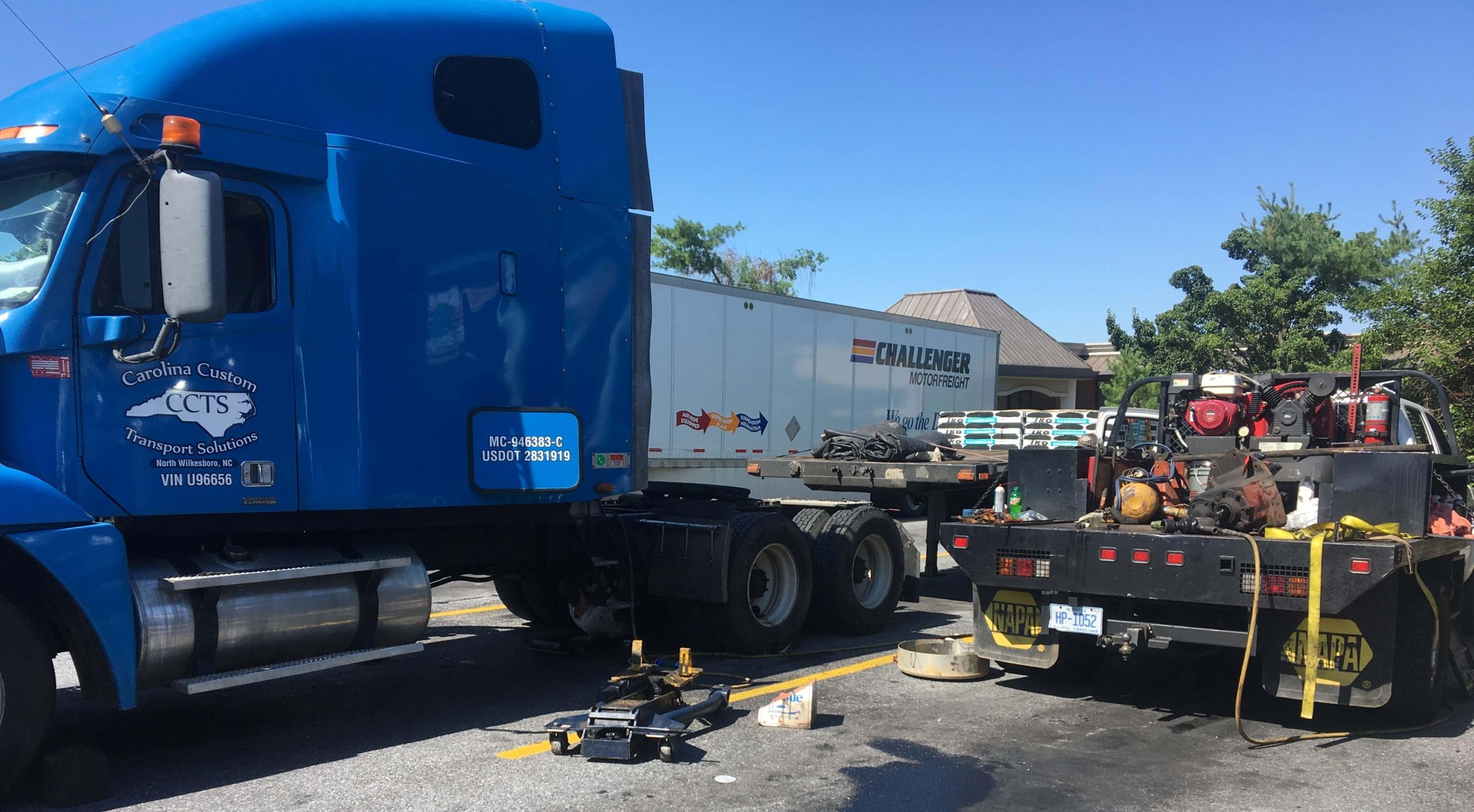
When your truck breaks down in the Blue Ridge Mountains on I-77, every minute counts. This corridor sees more breakdowns per mile than most routes due to steep grades, 2,000+ foot elevation changes, and challenging weather. Whether you're running refrigerated freight or managing a fleet, this guide gives you the critical information needed to handle emergencies from Fancy Gap to Statesville.
The I-77 mountain corridor presents unique breakdown challenges that require specific knowledge and preparation. From brake failures on steep grades to emissions system problems caused by elevation changes, understanding your options can save thousands in downtime and prevent minor issues from becoming major disasters.
Immediate Safety Steps for Any I-77 Mountain Breakdown
Mountain terrain makes standard breakdown procedures more dangerous. Follow these critical steps:
First 60 Seconds:
- Activate four-way flashers immediately
- Look for safest available stopping location
- Continue moving at reduced speed until you find suitable pullout
- Never stop in travel lane or on narrow mountain shoulder
Secure Your Location:
- Position truck as far right as possible while maintaining stability
- Place warning triangles at 10', 100', and 200' behind vehicle
- On steep downgrades, place furthest triangle even farther back
- Account for sight-distance limitations around curves and hills
Critical Checks:
- Check load securement immediately after stopping
- Contact dispatcher/emergency services ASAP (spotty cell coverage)
- Have location ready: mile marker, direction, nearest exit
- If hazmat load, follow special notification procedures
Emergency Communications:
- Mile marker numbers provide most accurate location
- GPS coordinates from smartphone as backup
- Note nearby landmarks visible from your location
- Stay with your vehicle unless unsafe to do so
Mile-by-Mile Breakdown Response Guide
Each section of I-77 presents different challenges. Here's what you need to know:
Virginia Border to Mile Marker 20 (Fancy Gap Section)
The Fancy Gap mountain section represents the most challenging and breakdown-prone stretch of the entire I-77 corridor. This area combines the steepest sustained grades with tight curves and limited shoulder space, creating maximum stress on all truck systems. Breakdowns here often involve overheating, brake problems, or transmission issues caused by the demanding terrain, and the remote location means longer response times and more limited repair options.
Mile Markers 0-8: The Notorious Grade
- 7% sustained grade with tight curves
- Most common failures: Engine overheating, transmission problems, brake fade
- Do NOT push through with overheating - grade continues for miles
- Use runaway truck ramps if brake problems develop
- Reid Diesel response time: 35-45 minutes
- Limited roadside repair options due to terrain
Mile Markers 8-15: Hillsville Transition
- Common issues: Electrical problems, DPF/DEF warnings after grade stress
- Better access for emergency services than grade sections
- Systems may fail as they cool down from climbing stress
- Good location for specialized services like DPF diagnostics
Mile Markers 15-20: Critical Decision Zone
- Terrain levels out - tempting to continue with warning signs
- STOP for professional assessment if you had ANY warnings during climb
- Safer terrain for roadside diagnostics
- Multiple repair facility options if towing needed
Mile Markers 20-50 (Northern NC Rural Section)
This rural stretch through northern North Carolina offers easier terrain than the mountains but presents isolation challenges that can extend breakdown recovery times. The rolling hills still stress truck systems, while the sparse population and limited infrastructure mean fewer immediate support options. Cell coverage can be spotty, making communication with dispatchers and emergency services more difficult.
Challenges:
- Limited cell coverage in valleys and dense tree areas
- Few service options - plan for extended response times
- Rural roads make vehicle location difficult
Response Strategy:
- Establish communication immediately when possible
- Ask other drivers to relay messages if needed
- Reid Diesel response: 35-45 minutes (fastest in area)
- Be specific about location - use multiple reference points
Plan Ahead:
- Limited food, restrooms, shelter during repairs
- Weather can change rapidly
- Prepare for potentially uncomfortable waiting conditions
Mile Markers 50-85 (Elkin-Jonesville Section)
The Elkin-Jonesville section serves as the strategic midpoint of the I-77 corridor, offering the best combination of reasonable terrain and good service accessibility. This area's rolling hills are less demanding than mountain grades but still create enough mechanical stress to reveal problems that began elsewhere. The proximity to truck stops and other commercial facilities makes extended breakdowns more manageable for drivers.
Strategic Location:
- Midpoint between service areas
- Rolling terrain stresses systems differently
- Better access to amenities than northern sections
Reid Diesel Advantage:
- Response time: 15-25 minutes (our fastest coverage area)
- Ideal terrain for mobile diagnostics and roadside repairs
- Access to truck stops and driver facilities
Common Issues:
- Systems stressed by rolling grades
- Problems discovered during fuel stops
- Good location for most types of roadside repair
Mile Markers 85-100 (Mount Airy Approach)
The Mount Airy approach area represents the transition from rural corridor to major junction complexity, with the I-74 intersection creating both opportunities and challenges. This section sees high truck traffic volume and offers excellent service infrastructure, making it the last major decision point before entering the challenging mountain sections to the north. The concentration of truck stops and repair facilities provides multiple options but also creates traffic congestion that can complicate emergency response.
Junction Complications:
- I-74/I-77 junction creates traffic complexity
- Try to reach truck stop vs. stopping on ramps
- High traffic volume requires extra safety precautions
Service Advantages:
- Last major service area before mountains (northbound)
- Multiple truck stops and parts suppliers
- Address ANY warning signs here before continuing north
- Reid Diesel response: 25-30 minutes
Winter Mountain Breakdown Protocol
Winter conditions make I-77 mountain breakdowns potentially life-threatening. Key differences:
Immediate Dangers:
- Exposure risk during extended waits
- Diesel fuel gelling can disable truck completely
- Ice/snow create slip hazards around vehicle
- Visibility reduced in storms
Winter Safety Kit:
- Extra warm clothing and blankets
- Emergency food and water (24-hour supply)
- Flashlights with extra batteries
- Cell phone car charger
- Ice scrapers and snow removal tools
Special Procedures:
- Don't repeatedly try starting if fuel gelling suspected
- Keep flashers operating - snow can cover lights
- Be extremely careful exiting vehicle on ice
- Focus on staying warm over attempting repairs
Self-Repair vs. Professional Help: Quick Decision Guide
Call Professional Help Immediately:
- Brake system problems
- Engine overheating or temperature warnings
- Steering issues
- Any breakdown on steep grades
- Emissions system warnings (DPF, DEF)
- Electrical problems affecting critical systems
Consider Self-Repair Only If:
- Simple issues like burned-out lights
- Loose connections you can safely access
- Minor fluid leaks not affecting operation
- You have proper tools and experience
- Safe location away from traffic
Mountain-Specific Risks:
- Never work in traffic areas on mountain grades
- Weather can change rapidly - get help before conditions worsen
- Sloped surfaces make simple tasks dangerous
- Limited escape routes from traffic
Why Choose Reid Diesel for I-77 Emergencies
Strategic Location Advantage: Our Exit 270 location provides fastest response throughout the mountain corridor - 30-45 minutes average vs. hours from distant shops.
Mountain Expertise:
- ASE-certified technicians experienced with elevation-related failures
- Understand how grades stress cooling, brake, and emissions systems
- Stock parts for common mountain breakdown scenarios
- 15+ years serving I-77 corridor
Complete Capabilities:
- Emergency roadside repair with fully equipped mobile units
- Heavy-duty towing when roadside repair isn't possible
- Load shift services for cargo emergencies
- Full facility for major repairs when needed
Frequently Asked Questions
What information should I have ready when calling for mountain corridor emergency service?
Have your exact location including mile marker number, direction of travel, and nearest exit number. Describe your truck's make, model, and year, along with the specific symptoms you're experiencing. If you're carrying hazardous materials or time-sensitive cargo like refrigerated goods, mention this immediately as it affects response priorities and repair approaches.
How do weather conditions affect emergency response times in mountain sections?
During severe weather, response times may be extended for safety reasons, but we maintain service availability throughout normal winter conditions. Our technicians are experienced with mountain weather challenges and carry equipment for working in cold, wet, or icy conditions. During severe storms, we coordinate with state highway departments and may recommend waiting for improved conditions rather than attempting dangerous roadside repairs.
Can Reid Diesel handle specialized trucks and equipment that travel I-77?
Yes, our technicians have experience with a wide range of specialized commercial vehicles including refrigerated trailers, heavy haul equipment, tanker trucks, and vehicles with hydraulic systems. We stock parts and tools for these specialized applications and understand the unique requirements for keeping temperature-controlled and other sensitive cargo protected during repairs.
What if my breakdown occurs during peak travel times or holidays?
We provide true 24/7 emergency service with live phone answering even during holidays and peak travel periods. During busy travel times, we may prioritize calls based on safety factors and cargo sensitivity, but we respond to all emergency calls. Peak periods may result in slightly longer response times, but we staff appropriately for high-demand periods.
Do you work with insurance companies and roadside assistance programs?
We work with all major commercial insurance providers and fleet roadside assistance programs. We can bill directly to approved accounts and provide the detailed documentation required by insurance companies. We accept Comdata, EFS, T-Chek, and other major fleet cards, and can provide immediate cost estimates for dispatcher approval.